
Festo CP Factory
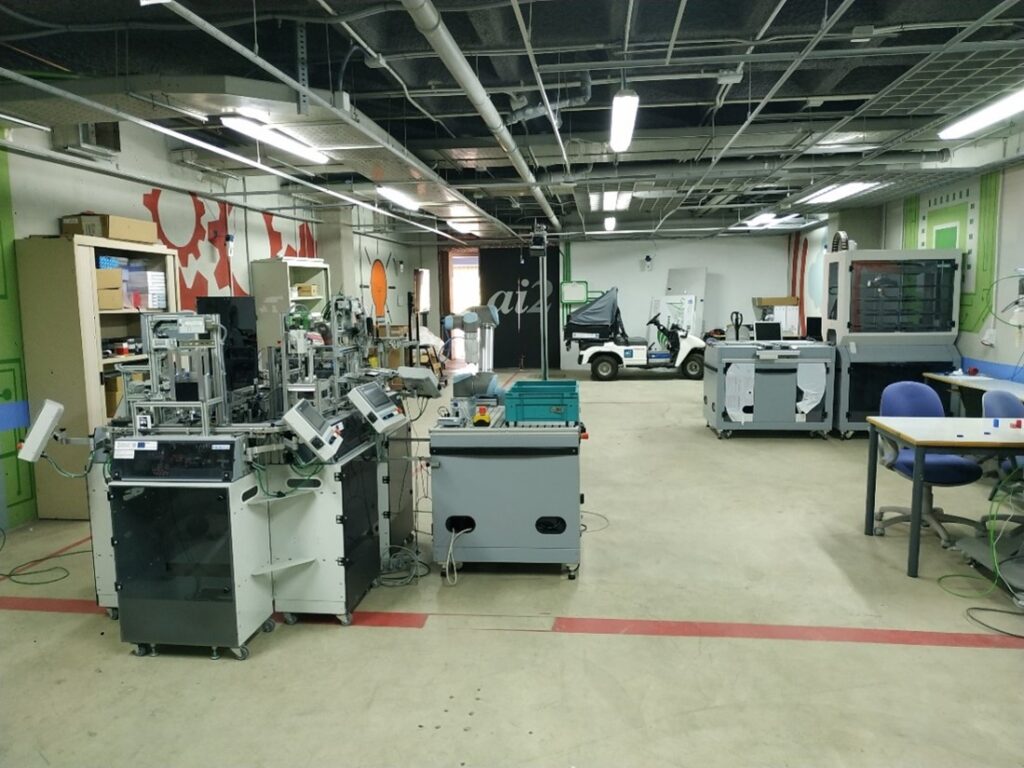
The CP Factory from Festo is a system consisting of several workstations, linked by conveyor belts, which simulates a product assembly line from the automated warehouse to the finished product. The process is controlled at all times by the commands sent by the Festo software, MES4, installed on a PC in the laboratory, which communicates with the PLCs at each workstation. Each PLC has an OPC-UA server from which data can be retrieved from the station.
The MES4 software operates on the database “FestoMES.accdb”, so that all operations occurring during the process are read/written from this database.
Each workstation is assigned an operation when a product identified by RFID technology arrives. In this way, the MES4 software is aware at all times of the operations carried out so far and those still to be carried out.
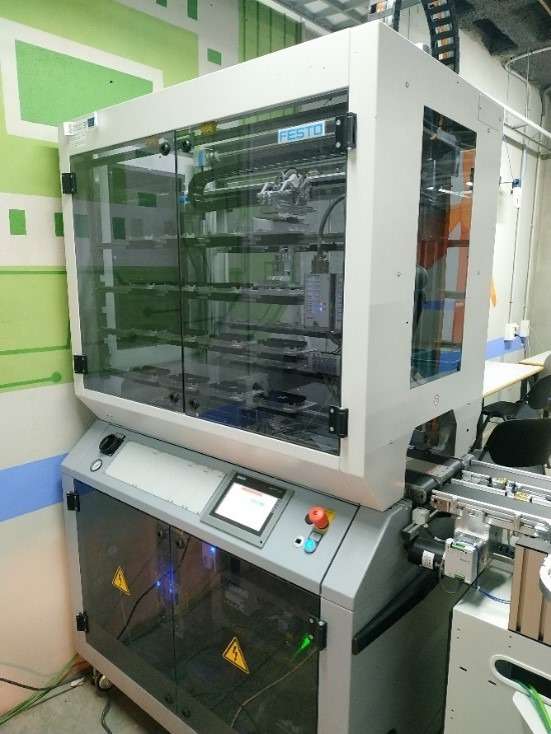
Parts warehouse
The first part of the assembly process consists of the output of the material from a warehouse. The warehouse is a closed cabin with 32 slots (16 at the front and 16 at the back) for storing material, placed on top of pallets that can be picked up by an automated arm with two Festo motors and drivers, one for the X axis and one for the Z axis.
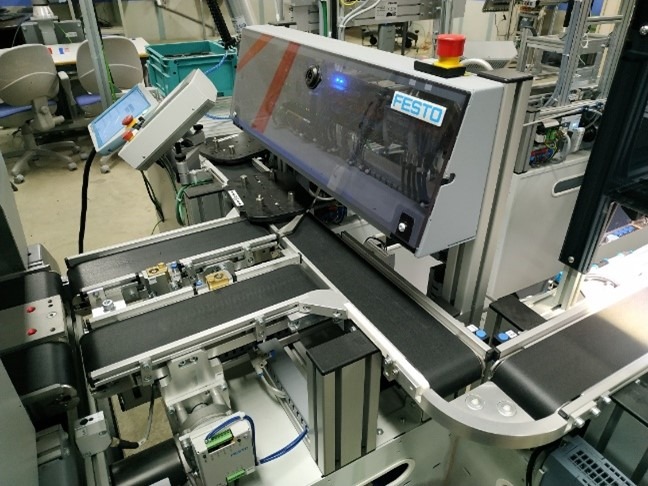
Linking tape
The link conveyor belt is the device that links the warehouse input and output with all other workstations. This conveyor is not controlled by a Siemens PLC, but by a Festo CECC-LK, programmed in the CoDeSys development environment.
The transfer conveyor checks the incoming part and verifies that it is correctly finished in order to send it back to the finished product warehouse or to continue to the next station if it still has operations pending (for example, if an operation could not be carried out correctly previously). To do this, it has a pallet that sends the material to one conveyor belt or another.
Inspection chamber
Station with an inspection camera that verifies that the part is correctly placed on the pallet. If the part does not exist or is incorrectly positioned, this station generates an alarm.
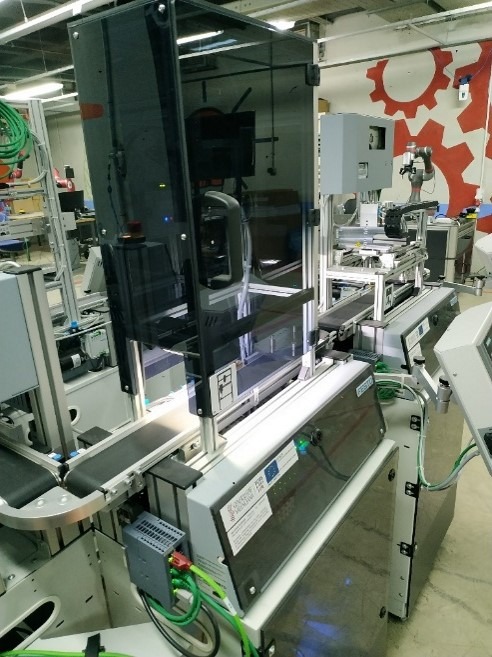
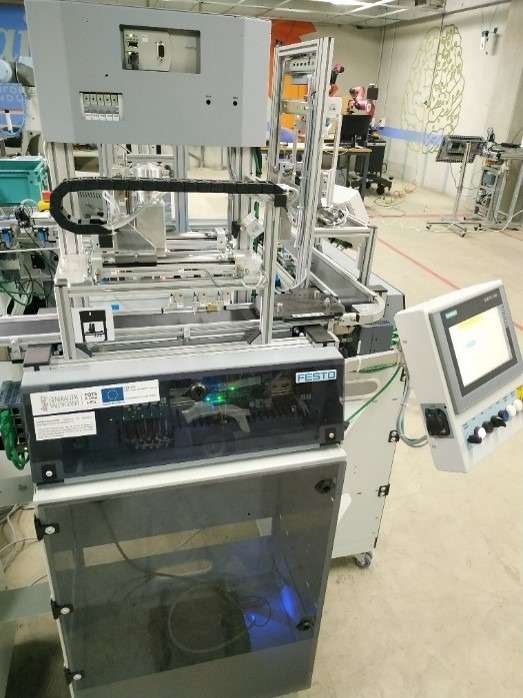
Drilling station
Station that simulates the drilling of holes in the part to be manufactured. It consists of two parallel drills that can operate in two possible positions. The station can be configured to drill holes in only one position or in both.
Upper part assembly
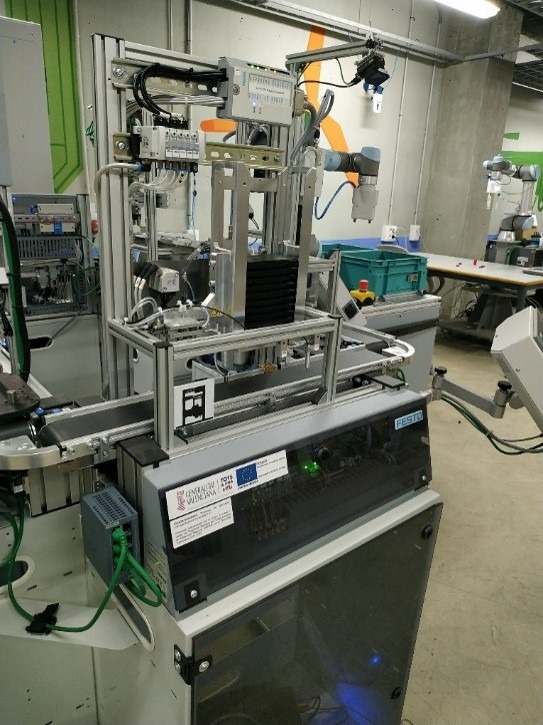
Station consisting of a parts magazine that drops the top piece of product onto the pallet. When the pallet is placed on the station, a pneumatic piston drops a part from the magazine. In the event that this operation cannot be carried out due to a lack of material, an alarm is generated on the station panel.
Pressing station
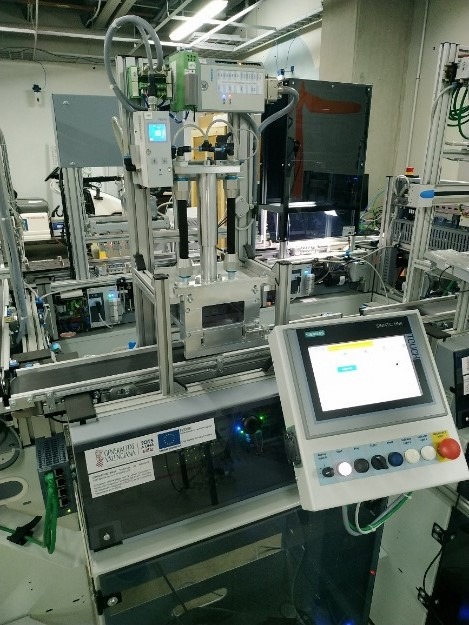
A pneumatic press presses the upper material at a controlled pressure to ensure correct assembly of the product. The setpoint of the press is controlled by an analogue signal.
Material output
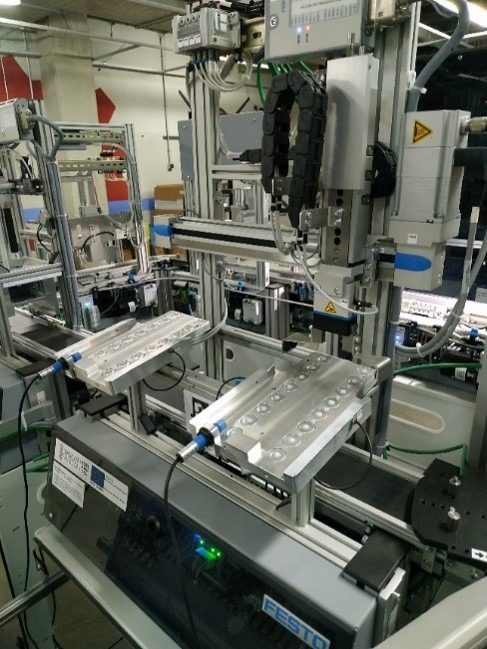
When the finished part is placed in the station, grippers controlled by a pneumatic piston and a small servomotor pick it up and place it in two possible tanks. Each tank has a maximum capacity of 2 pieces. The filling of pieces will be done starting with tank 1, and will not move on to tank 2 until the tank is full. If both tanks are full, an alarm is triggered.
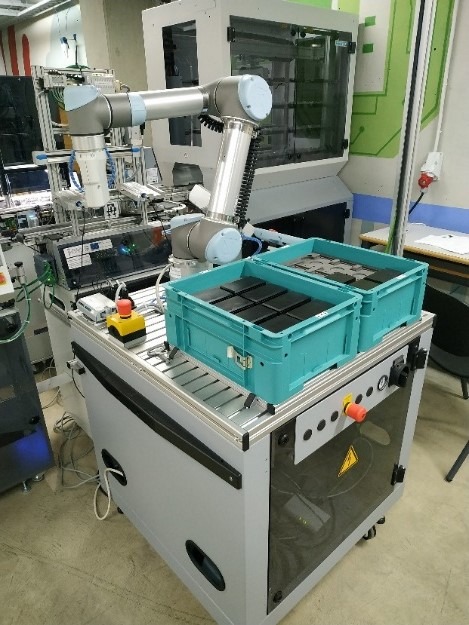
Palletising station
It consists of a UR5 collaborative robot that collects the parts from the previous depots and palletises them into two boxes with a maximum capacity of 8 parts/box. Currently, this station is not connected to the MES4 and its operation is independent. The robot executes the programme every time the detectors in the depots notify that a part is available for collection.